

Day 124 Kid Gore Shelter to Stratton Pond Shelter
More from this trailInspiration, move me brightly
If you were looking for ground zero of the long distance hiking world, you would come to Stratton Mountain.
James P. Taylor sat in his tent there on a rainy day in 1909 when he was struck by an idea. He wanted to construct a hiking trail through the entire state of Vermont, extending from the state's southern border with Massachusetts to the northern border at Canada.
Taylor quickly moved on his idea, and by the next year, work had begun on what was called the Long Trail. When the 272-mile trail was completed in 1930, it was the first long distance recreational hiking trail in the United States.
While the Long Trail was being constructed, Benton MacKaye visited this same site, and he too dreamed of a long trail. He took Taylor's idea and extended it into an even more audacious plan. He wanted to build the Appalachian Trail, which would traverse the entire length of the Appalachian Mountain Range.
For now, I’m still walking the footpath shared by the Long Trail and the Appalachian Trail. A couple more days north of here, the AT will turn away and take its own path into New Hampshire and Maine.
Rain was still falling when I woke up at 5 a.m. It stopped within an hour, just as I was packed and ready to take down my tent.
Before leaving camp, I spent more time trying to repair my broken pack. It was still causing problems, and I was becoming so frustrated with it I hoped to buy a new one at an outfitter store in Manchester Center.
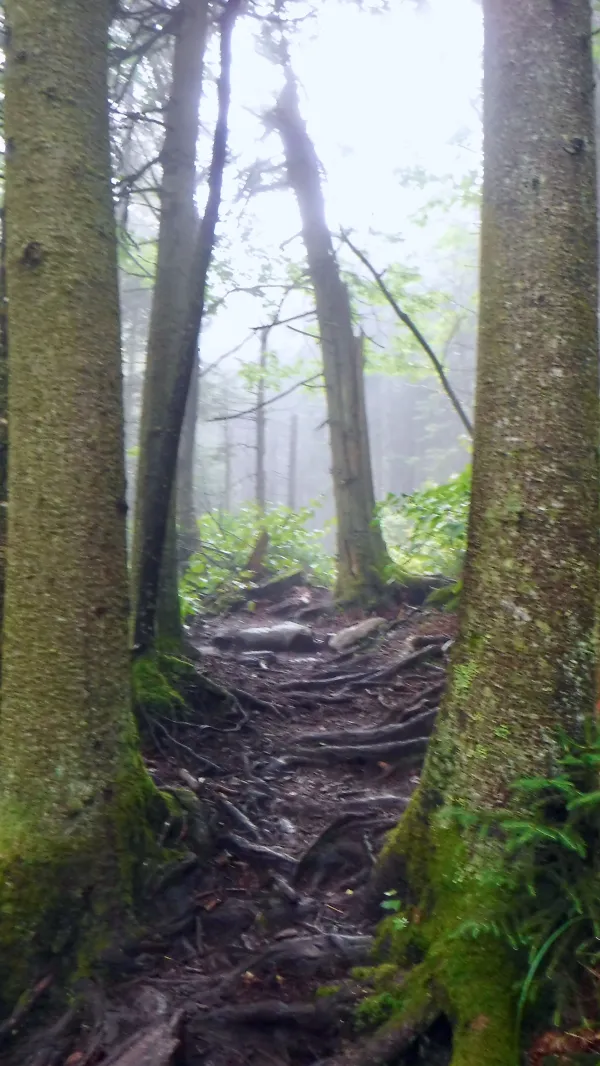
Roots and mud on the trail
For much of the morning, I felt as though I was walking in slow motion. One look at the footpath might explain why I thought that. It was full of mud, roots and rocks.
At a couple intervals along the way, I compared my time against the distance I covered. Surprisingly, I was moving at a reasonably normal speed.

Mud on rocks
An overnight rain made the trail a mess.

Beaver bog
The trail took me past a beaver bog. Their house sat in the middle of the pond.
I stopped for lunch and water less than a half mile past the bog at Story Spring Shelter. Becky and Stick were also there.
One thing I’ve noticed so far about Vermont is that the shelters are spaced more closely together than on other sections of the trail. They are also mostly older.
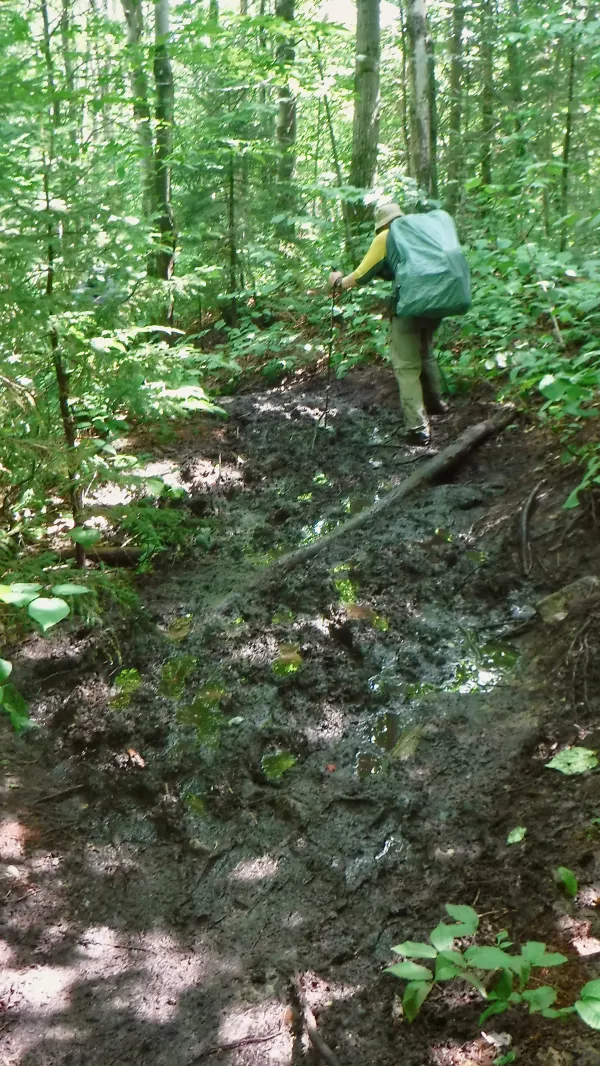
Stick on climb up Stratton Mountain
After a gradual, three-mile descent, the trail began a four-mile climb that was sometimes steep as it went up Stratton Mountain.
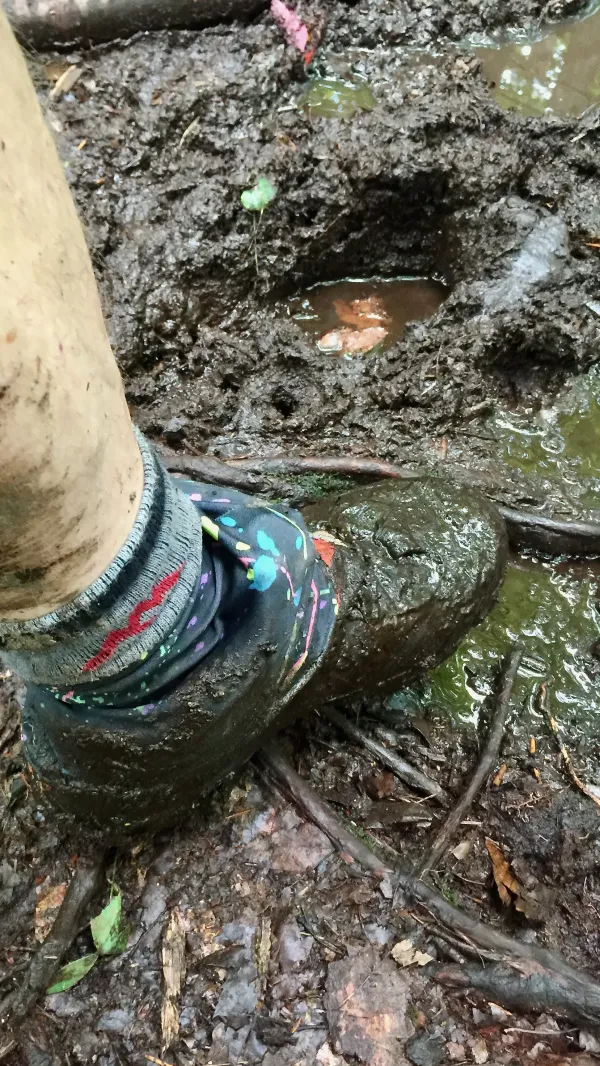
Muddy boot
The trail was especially sloppy going up the mountain. At just under 4,000 feet in elevation, Stratton's summit was the spot that inspired Taylor and MacKaye to build two long distance hiking trails.
A short side trail was nearby, which led to Stratton Mountain Resort. Several ski runs operated there during the winter.
A couple of tourists arrived at the summit about the same time I did. They said they rode a ski lift to the resort before walking the easy trail to the summit.

Stratton Mountain caretaker cabin
As I looked around the mountaintop, I saw a small, white cabin. It was used by forest rangers when they watched for fires from a fire tower, which still stood nearby.
The cabin now serves as a home during the summer for a couple who work here as caretakers. Their names are Hugh and Jean Joudry.

Stratton Mountain caretaker Hugh Joudry
I didn’t get a chance to meet Jean, but had a long chat with Hugh. He told me they have served as caretakers since 1968.
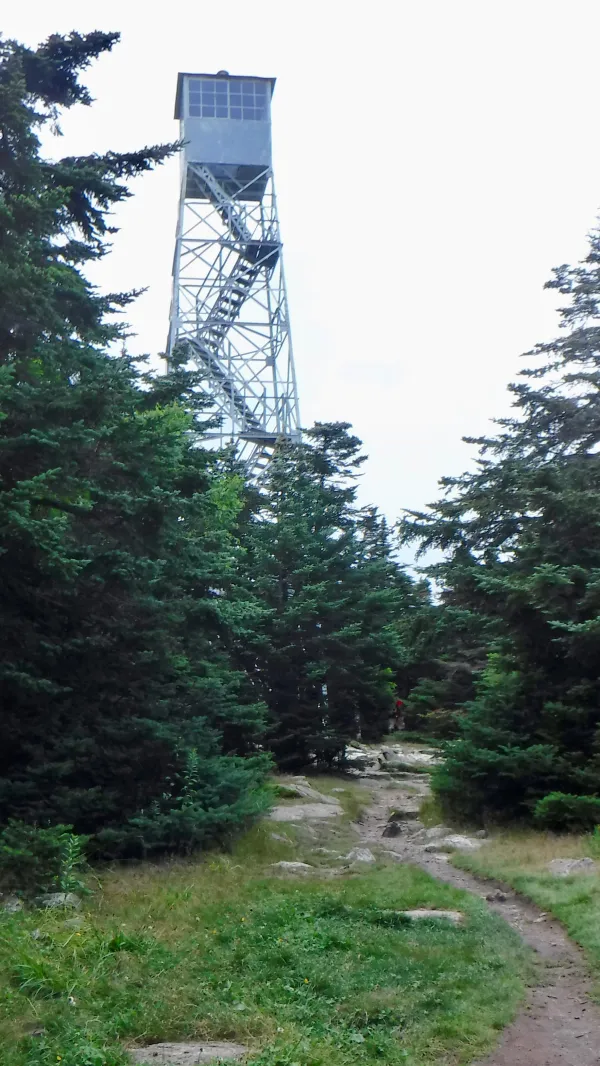
Stratton Mountain tower
The tower was built in 1934 and remained in service for spotting fires until 1982. It continues to be well-maintained.

View from Stratton Mountain tower
I climbed to the top. The view was obscured by rain clouds moving closer and closer to the mountain. Wind made the tower shake, and it seemed a storm was on the way. I didn’t stay at the top long.
A thunderstorm swept across the mountain just as I left the summit. That made the trail on the descent more of a slog than the climb had been.
The rain stopped by the time I arrived at Stratton Pond Shelter. I was greeted by Chris, a caretaker employed by the Green Mountain Club to work there during the summer. He was responsible for the shelter and a hiker campground on the north shore of the pond.
To help defray costs and keep the area from being overcrowded, Chris collected a camping fee of five dollars.
Tenting was not allowed at the shelter. If we wanted to camp in our tents, we would have had to continue down the trail to the pond, then follow a side trail to the campsite. With the recent rain and more in the forecast, we decided to sleep in the shelter. For Becky and Stick, this was their first night in a shelter.
While I heated water for my mashed potatoes and pepperoni dinner, I looked on as Becky tried to light her stove. Suddenly, it burst into a fire ball. Stick tried to blow out the fire and singed his beard.
I couldn’t help myself. Impulsively, as if we were in a Greek restaurant and a waiter had just set fire to a cheese appetizer, I shouted, “Opa!”
I doubt anyone saw my humor in the moment, and thankfully, no one was hurt. After a second try, Becky was able to light her stove and cook dinner.
Stick’s beard was only slightly shorter than before. When we realized that, everyone began to laugh.
The shelter was a tall, two-story structure. Once dinner was done and our bear bags hung, we climbed to the loft and stretched out our sleeping pads and sleeping bags. It was dry and not too chilly up there, but got a little noisy when rain started falling again, hitting the shelter’s metal roof.
Inspiration, move me brightly
Light the song with sense and color
Hold away despair
More than this I will not ask
Faced with mysteries dark and vast
Statements just seem vain at last
Some rise, some fall, some climb
To get to Terrapin
This trail report was published